Pints for Prostates

Showing posts with label brew day. Show all posts

Tuesday, January 15, 2013

Kingmaker Saison

I named this beer “Kingmaker” after the song of the same name by Big Big Train on their album Far Skies, Deep Time. I was listening to the album on brew day and I liked the name.

The plan for this beer is to use the Wyeast French Saison yeast for the primary fermentation, transfer the beer to a secondary glass carboy and pitch Brettanomyces B. The beer will be in secondary for four to six months. Currently, the beer is a month into secondary fermentation and I’ll make another post about the Brett B fermentation.  
3711 French Saison Yeeast
Brew Name: Kingmaker Saison
Brew Date: 2012-11-21
Batch Number: B12

Recipe Specifics
Batch Size (gal): 5.5
Total Grain (lbs): 13.75
OG: 1.062
Wort Boil Time: 90 min.
Rolling Boil

Grain
11.5 lbs Pilsner
1.5 lbs Flaked Oats
.75 Crystal 60
US Hops - Palisades, Chinook, US Saaz
Hops
.5 oz Palisades @ 60 min
.5 oz Palisades @ 20 min
1 oz Chinook @ 15 min
1 oz US Saaz @ 10 min

Extras
5 ml Lactic Acid
4 grams Epsom Salt
2 grams Calcium Chloride
2 grams Baking Soda
1/2 tab Whirlfloc @ 15 min
1/2 tsp Yeast Nutrient @ 15 min

Yeast
3711 French Saison (in primary)
WLP650 Brettanomyces Brux (in secondary)
Hoppy Kreusan
Mash Schedule
Sacch rest 60 min @ 149 F
15 min @ 149
15 min @ 160
Carboy and Blow Off Tube
Notes
- Inspired by "Saison of Zen," page 26 of Zymurgy, vol 35, no 6, Nov/Dec 2012.
- Would have liked another gallon of starter wort
- To secondary on 2012-12-09 with Brett B.

Thursday, December 20, 2012

Session IPA Recipe

The following is the recipe I used for my Session IPA.

Brew Name: Session IPA #1
Brew Date: 2012-10-14
Batch Number: B11

Recipe Specifics
Batch Size (gal): 5.5
Total Grain (lbs): 9.30
OG: 1.026 (!!)
Wort Boil Time: 60 min.

Grain
4 lbs Maris Otter
4 lbs Canadian 2-Row
1.09 Victory Malt
1 lb Rye Malt
.30 lb CaraPils

Hops
.25 oz Columbus @ 60 min
.5 oz Galaxy @ 20 min
1 oz Palisades @ 15 min
.5 oz Columbus @ 10 min
.5 Galaxy @ 5 min
1 oz Galaxy @ 0 min
.25 Columbus @ 0 min


Extras
5 ml Lactic Acid
2 grams Epsom Salt
2 grams Calcium Chloride
2 grams Baking Soda
1/2 tab Whirlfloc ?
1/2 tsp yeast nutrient ?


Yeast
WLP023 Burton Ale
2 liter starter w/ 200g DME

Mash Schedule
Sacch rest 60 min @ 156 F
No Sparge (!!)

Notes
- Not sure if I added whirlfoc and yeast nutrient.
- Brew day music: Big Big Train - English Eccentric Part 1, Yes - Drama, Fly From Here
- Critical error of no-sparge caused the beer to be under-attenuated and very bitter. I think the recipe is viable, but full sparges and maximum fermentables are needed.
- See the Session IPA Debacle post.

Wednesday, December 19, 2012

Session IPA Debacle

India Pale Ale is my favorite style; that’s what I drink the most. I like a beer with lots of citrus and pine resin hop flavor. A beer with 70 IBUs doesn’t daunt me. Understandably, that is the beer style I like to brew the most. A five gallon Cornelius keg of a tasty IPA is sure to be emptied.

The BJCP style guide has an ABV of 5.5 to 7.5% for IPAs. That doesn’t stop people from making more session-able IPAs (or hoppy blond ales) that have less alcohol, but good flavor. Founders All Day IPA is an example of a session ale with 4.7% ABV. Lagunitas DayTime is another, with an ABV of 4.65%.

This fall I brewed a session IPA. Unfortunately, the beer did not come out well. I created the recipe, but I don’t think the recipe is bad. I think the problem derives from one process decision I made that proved to be a critical mistake.

I had read somewhere that one way to bring down the amount of fermentables in the wort (and therefore get lower gravity) is to just take your first runnings and then add water to get to your pre-boil volume, as opposed to couple batch sparges. That sounded easy and it was sure to cut at least a half hour off my brew day. I didn’t realize the house of cards I was playing with.

After the fact, I can see that this chosen method had a few consequences:
  • The straight water that was added did not get treated with the same water additions (Epsom salts, Calcium Chloride, etc.) as the mash water. That means that my water chemistry and ph was off. The yeast probably wasn’t happy about that.
  • Because I only used the first runnings, the gravity was low; lower than the calculations in my BeerSmith software. To make matters worse, I added about a gallon more water than I needed, which made the gravity even lower. The low gravity meant that the yeast did not have as much fermentables to grow on. Again, the yeast was not happy. The carboy had extra yeast residue on the inside walls of the carboy and on the surface of the beer.
  • The hops that I added were based on a recipe with a certain grain bill and gravity. The lower gravity meant that there were too many IBUs (bitterness) for the resulting beer.
The beer ended up cloudy, yeasty, and bitter. Undrinkable. I tried it each week, and it improved slightly, but not good enough.

It’s a bummer that the beer went bad. But, I can say that I learned something from the experience. I might wait for the sting to wear off some before I try to brew that recipe again.

Tuesday, September 18, 2012

Ezra Saison

To conclude the summer of Belgian beers, I brewed a Saison on 2012-08-27. I used Jamil Zainesheff's Raison D'Saison recipe in his Brewing Classic Styles book. My recipe deviated some. I added fresh lemon thyme from our garden, chamomile flowers, and crushed coriander. My hop additions deviated some too.

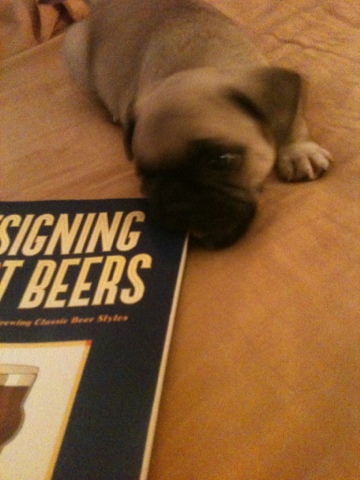
The beer is named after our new French Bulldog/Pug ("Fug") puppy, Ezra. Hopefully the beer will be good enough to represent such a cute puppy. If not, I'll name some other beer after him. He's my new brew buddy. He's already very fascinated about the beer ingredients and brewing process (when he's not napping). You can see in the photo below that he wanted to eat help me design a beer. 
Ezra wants to design a beer recipe (I think)
I want to use a new format for describing my brew day data. It's loosely based on the format used on the Mad Fermentationist blog.

Ezra Saison

Recipe Specifics
Batch Size (gal): 5.5
Total Grain (lbs): 11.76
OG: 1.052
Wort Boil Time: 90 min.

2 liter starter

Grain
10.5 lbs Pilsner malt
.51 lb wheat malt
.75 lb Munich malt
67 g Caramunich

Hops
1.0 oz Hellertau (3.8 AA) @ 90 min
1.0 oz Hellertau @ 42 min
1.0 oz Hellertau @ 0 min

Extras
1 g lemon thyme @ 5 min
5 g chamomile flowers @ 5min
11 g crushed coriander @ 5 min

1/2 tab Whirlfloc
1/2 tsp yeast nutrient

Yeast
Wyeast 3711 French Saison

Mash Schedule
Sacch rest 90 min @ 147 F
Sparge 1 20 min @ 147 F
Sparge 2 15 min @ 150 F

Notes
Made a 2 liter starter (2012-08-26). 117 g of DME (I was short on DME). About 3 tbsp sugar added. Shook a few times. Decent, but not great start.

First brew day with Ezra. He liked the spent grains.

FG: 1.004 on 2012-09-18  
Ezra eating handful of spent grains

Friday, August 3, 2012

Belgian Pale Ale

I was planning on brewing on Sunday. For me and my family schedule, Sunday is a good day to fill the kitchen with brewing equipment, turn on music, and boil water/wort.

However, this Sunday I just wasn't feeling it. Brewing requires a lot of physical and mental energy and approximately five, contiguous hours of time. I was tired. I wanted to sit in the sun and read. I figured that if I pushed myself to brew I would not enjoy it as much, and I don't want to risk associating a poor experience with a hobby that I enjoy.

Arguably, it's possible that I could have started to brew and found myself enjoying the act of measuring grain to mill, stirring the resulting grist in the mash tun, or the pungent aroma of the first, bittering addition of hops to the rolling boil of brown wort.
UK Kent Goldings
Wort


...Not only is it possible, it's likely.

But there are other days to brew.  I ended up brewing on Tuesday (2012-07-31) after work. I knew that with some time to listen to a couple episodes of brewing podcasts (e.g., Basic Brewing Radio, Brewing Network's Sunday Session), calculate mash water volume and temperature, and determine mineral additions for the water, I would be eager to get home on Tuesday and brew. I was.

This time, I brewed a Belgian Pale Ale. The recipe is from Jamil Zainasheff's book, Brewing Classic Styles.  I followed his Antwerp Afternoon recipe, with minor deviations. My version is as follows:

11.3 lbs. German Pilsner malt
.75 oz. CaraMunich malt
4 oz. Belgian Biscuit malt

5 ml of Lactic Acid to mash
2 g of Calcium Chloride to mash
4 g of Epsom Salt to mash
2 g of Baking Soda to mash

1.3 oz. UK Kent Goldings @ 60 min.
1/2 tablet of Whirlfloc @ 15 min.
.25 teaspoon of yeast nutrient @ 15 min.
.7 oz. UK  Kent Goldings @ 0 min.

2 vials of White Labs WLP500 Belgian Ale yeast

1 oz. UK Kent Goldings dry hop in keg 

WLP500 Belgian Ale Yeast
If you have the book you can follow along with me. I am working my way through his Belgian and French Ale chapter. I brewed a Witbier at the beginning of July. I brewed a Belgian Pale Ale on Tuesday. Next, I will brew a Saison. I might brew a Biere De Garde too, we'll see. We can dub this the "Belgian Summer." It's also a means to use the large sack of German Pilsner base malt I have in the basement.

How did this get to be the summer of Belgian beers?

The Witbier was definitely for Kim. She likes the style and I wanted to make a beer that would have her sneaking downstairs to draw from the keg each evening. I have not written a review yet because, at this point, the beer is a bit green. I'm hoping the harsh flavors mellow and that the overall flavor improves. It's certainly drinkable, but not great.

I think the pint of BPA I had at Ommegang inspired this beer. I think that beer is fantastic. Besides, I have brewed a couple American Pale Ales already. Why not compare the brewing experiences and beer styles?

As I understand it, Saisons can be herbal, hoppy, and tangy. The style is supposed to be quite flavorful and a good pairing for many foods. It is a good base beer with which to experiment with herb and fruit additions. I would like to learn more about Saisons, both by reading about the style and by tasting more examples.


If I brew the Biere De Garde, I think the strong, malty profile will make for a good winter beer (the beer needs to be lagered for three months). As you can tell, I'm not sure I will brew it. I might find myself really wanting to make an IPA by then. 

Friday, July 13, 2012

Summer Witte

On July 2nd I brewed a witbier, a Belgian style beer brewed with wheat. The commercial examples use terms like "Belgian white" (e.g., Hoegaarden, Blue Moon) or "witte" (e.g., Ommegang Witte). It's a light golden but hazy beer with coriander and citrus flavors that are refreshing during the summer months.

Kim really likes Ommegang's Witte and wanted me to brew a witbier for her, and I was happy to oblige. Knowing that the beer requires warm fermentation temperatures, I held off on brewing it until summer.

I'm calling this beer, "Summer Witte." I brewed the beer at the beginning of July, it will ferment and carbonate during July, and we'll be able to drink the beer throughout August.

I was surprised by how excited I was about this beer. My wide-eyed glow came from the seasonings and hop additions that the recipe calls for. This beer has crushed coriander seeds, chamomile flowers, and orange zest. I opted to purchase whole leaf hops for the first time, which provided a sense of brewer tradition and aesthetic value. I was also happy with the yeast selection: two vials of White Labs WLP410 BelgianWit II - Platinum, a spicier version.
Hops, Coriander, Chamomile, Orange Zest
Kim helped me pick out the extra ingredients at the health food store. She crushed the coriander seeds and helped zest the oranges, which was no small job, six oranges total.
Zesty!
Brew Date: 2012-06-02
Recipe Name: "Summer Witte" (based on a Jamil's Wittebrew recipe)
Beer Style: Witbier
Batch Number: B8

Original Gravity: 1.050
Expected Final Gravity: 1.011
Expected ABV: 5.0%
IBUs (bitterness): 22.4
SRM (color): 4 SRM

Yeast: 2 vials of White Labs WLP410 Belgian Wit II

Water Chemistry: Remsen well water (Ca 84, Mg 10, Na 3, Cl 8, SO412, CACO3 228)
Added: 6 ml Lactic Acid, 3 g Epsom Salt, 1 g Calcium Chloride (to mash)

Recipe
5.5 lbs. German Pilsner
5.0 lbs. Flaked Wheat
.25 lb. Munich Malt
.5 lb. rice hulls

1.2 oz. Hallertau (leaf) @ 60 min.
.8 oz. Hallertau (leaf) @ 15 min.

1.3 oz. orange zest @ 5 min.
.4 oz. crushed coriander seeds @ 5 min.
.03 oz dry chamomile flowers @ 5 min.

1/2 tablet of Whirlfloc @ 15 min.
.25 tsp. yeast nutrient @ 15 min.
Flaked Wheat
Mash Schedule: 
> 15 min. @ 122 F
> rise from 122 to 154 F over next 15 min.
> 60 min. @ 154 F
> sparge @ 160 F for 15 min.
> sparge @ 170 F for 15 min.

Note: I was short about a gallon of water for my pre-boil volume.
Mash Music: Bon Iver iTunes Session, Phish Superball IX @ Watkins Glen 2011-07-03 (I should have listened to the 07-02 show!)

Boil Time: 90 minutes to reduce DMS
Boil Music: Brewing Network's Sunday Session podcast 2010-01-17 (Vinny from Russian River episode)
Whole Hop Boil
One of the process changes I made to this brew day was to siphon the wort form the brew kettle to the fermenter. I did that to reduce the amount of whole leaf hops in the fermenter. I used a lot of plastic wrap to reduce exposure. After, I managed to break my auto-siphon trying to get a hop leaf out of it. This is a typical problem apparently.

Fermentation Schedule: 
> 1 week @ 68 F
> 1 week @ 70 F
> 1 week @ 72 F

Monday, June 4, 2012

Free IPA

As cliche as it might be among craft beer aficionados these days, I have to say, I love a great IPA. I am always trying new IPAs and adding more to my "best of" list. One of the IPAs that I instantly went gaga over (a total BILF) was 21st Amendment's Brew Free or Die IPA. Great hop aroma, even more hop flavor, and almost no bitterness. A very smooth, late-hop-addition beer. That is what I want.
21st Amendment's Brew Free or Die IPA
A quick search and I was able to find a clone recipe. I do not know how close it is. If you compare that beer recipe to what I list below, you can see that I changed it some because Amarillo and Simcoe hops are hard to come by this time of year. They are both very popular hops. Instead, I added an ounce of Summit hops. Maybe not the best substitution, but whatever. I named the beer "Free IPA," as a reference to the clone beer and to the fact that I brewed it on Memorial Day.

Brew Date: 2012-05-28 (Memorial Day)
Recipe Name: "Free IPA" (based on a 21stAmendment Brew Free or Die IPA clone recipe)
Batch Number: B7

Expected Original Gravity: 1.069
Expected Final Gravity: 1.010?
Expected ABV: 6.2%
IBUs (bitterness): 70
SRM (color): 9.1 SRM
Expected Efficiency: 70%
Actual Brewhouse Efficiency: ?


Yeast Starter
Water Volume: 2 liters
Dry Malt Extract: 200 grams
Yeast: White Labs WLP001 California Ale Yeast
Yeast Nutrient: 1/4 teaspoon of LD Carlson Yeast Nutrient
Note: I forgot and used post-softened water for the starter. The yeast might have liked the pre-softened better.

Water Chemistry: Remsen well water (Ca 84, Mg 10, Na 3, Cl 8, SO412, CACO3 228)
Added: 3 ml Lactic Acid, 6 g Epsom Salt, 3 g Calcium Chloride (to mash)
Brewing Salts and Yeast Nutrient
As you can tell from my previous posts, the last couple months have been about trying to improve my water. With the second water report I was able to use a spreadsheet to determine what ought to be added and how much. To this point I have studied and acted according to what makes sense. Next, perhaps the taste of the beer will suggest what should be adjusted.

Brew Day Start Time: 8:05 AM
Music: Grateful Dead - Rocking the Cradle: Egypt 1978 (1978-09-15,16)
One of the tools I use to track my brew days and recipes (besides this blog) is my 2012 Brewer's Logbook from Basic Brewing. I listen to the Basic Brewing podcast each week and purchasing the logbook was a good way of saying thanks. The logbook has a calender so that I can plan brewing activities and pages to document significant information and notes about each brew day. Like the act of brewing, using a pencil and paper to take notes keeps me away from a computer screen for awhile.
My 2012 Brewer's Logbook
Grain Bill
11 lb Canadian Two-Row
1 lb 12 oz Munich Malt
12 oz Carapils

Mash
Strike Water Volume: 3.5 gal
Strike Water Temperature: 165 F
Mash Rest Temperature: 154 F
Mash Time: 60 min


I stirred the grain more than during previous brew days. It ought to help the conversion. 
Mash
Sparge #1
Sparge Water Volume: 2.0 gal
Sparge Water Temperature: 170 F
Rest Temp: 160 F
Mash Time: 15 min

Sparge #2
Sparge Water Volume: 2.5 gal
Sparge Water Temperature: 170 F
Rest Temp: 160 F
Mash Time: 15 min


I wanted the rest to be at 170 degrees for both sparges. As you can see, the temperature went down 10 degrees. Next time....
Composting Spent Grains
Pre-Boil Gravity: 1.050
Pre-Boil Volume: 5.3 gal (calculated)
Boil Time: 60 minutes (Note: It appears I deviated from the recipe here. The recipe calls for a 90 minute boil)

Hop Additions
1.00 oz Warrior @ 60 min
1.00 oz Centennial @ 20 min 
1.00 oz Columbus @ 0 min 
1.00 oz Cascade @ 0 min
1.00 oz Cascade dry hop @ 3 days
1.00 oz Summit dry hop @ 3 days
1. 00 oz Styrian Goldings dry hop @ 3 days


I should mention that I also added 1 teaspoon of yeast nutrient and 1 half tablet of Whirlfloc @ 15 minutes left in the boil.
Lots of Hops!

All Green and Chillin'
Original Gravity: 1.058
Brew Day End Time: 1:30 PM   

Fermentation Schedule
Week 1: target of 67 F, with incubator set around 18 C
Week 2 and 3: target 67 F, with incubator set to 19.4 C
3 days at 35 F (? still researching what a good cold break temp is)
3 days at 67 F with dry hop, then rack to keg
New Incubator with  Fermenter and Blow-off Tube
This incubator is my new baby. It cools and heats, maintains the temperature I want, in Celsius. This fermentation tank will allow me to brew throughout the summer and keep a consistent temperature. I was able to buy it cheap off of craigslist. (Shout out to my friend Howie for helping me transport it. It was a nice Sunday drive in the sun, windows down, music playing.)

Thursday, March 29, 2012

Late Summit

My latest brew is an American Brown Ale called, "Late Summit" because I added an ounce of Summit hops late in the boil (i.e., a late hop addition). Summit hops are high alpha hops. In fact, the pellet hops I used are 17.9% alpha. Summit hops are a "super-high alpha dwarf variety grown on low trellis systems in Yakima valley" (source). They are known for having a funky, earthy, tangerine character. I'm hoping for kind dankness, tangerine, and citrus flavor.
In the Morning
Brew Date: 2012-03-27
Recipe Name: "Late Summit" (based on Jamil's "Dirty Water Brown")
Beer Style: American Brown Ale
Batch Number: B6

Recipe Original Gravity: 1.048
Recipe Final Gravity: 1.011
Expected ABV: 4.9%
Anticipated IBUs (bitterness): 36-38
SRM (color): 20
Expected Efficiency: 70%
Calculated Brewhouse Efficiency: 73% (using 6.5 gal for wort volume)

Yeast Starter Size: 2 liter
Water Volume: 2 liters
Dry Malt Extract: 200 grams
Yeast:
White Labs WLP001 California Ale Yeast 

Grain Bill
10 lb Canadian Two-Row
.5 lb Crystal 40L
.5 lb Chocolate Malt
.75 lb Crystal 60L
.75 lb Victory
Everything but the Kitchen Sink
Brew Day Start Time: 3:15 PM
Music: Grateful Dead - Dick's Picks 14 - Boston Music Hall, 1973-11-30 & 1973-12-02

All the water used for this beer is straight from our tap. We have well water and the pH is between 6.5 and 7. My understanding is that the darker malt will bring the pH down toward the 5.2 range, which is ideal.

Mash
Strike Water Volume: 4 gal
Strike Water Temperature: 165 F
Rest Temperature: 152 F
Rest Time: 60 min 
Brown Vorlauf

Sparge #1
Sparge Water Volume: 2.5 gal
Rest Temperature: 170 F
Rest Time: 5 min

Sparge #2
Sparge Water Volume: 2 gal
Rest Temperature: 170 F
Rest Time: 5 min

Pre-Boil Gravity: 1.044
Pre-Boil Volume: ~ 6.5 gal
Boil Time: 60 min
Rolling Boil
Hop Additions
10 grams Horizon @ 60 min
1 oz Amarillo @ 15 min
1 oz Summit @ 5 min

Yeast Starter and Hops
Actual Original Gravity: 1.050
Brew Day End Time: 7:32 PM
Fermentation Temperature: 64 F
It's taking off! Thursday night (29th)
I'm excited about this beer. Everything went really smooth during the brew day. My starter ramped up nicely. My gravity readings were fairly close to Jamil's recipe. I'm also excited about the hop additions. What makes this brew particularly enjoyable is being able to see the beer as it ferments in my clear, Better Bottle carboy. This is the first time I can see the fermentation process. The whole thing is alive with yeast cells. I check on it every morning and first thing after work...and after dinner...and before bedtime.

Thursday, March 8, 2012

Acoustic Cream Ale

Brew Date: 2012-02-26
Recipe Name: "Acoustic Cream Ale" (based on Jamil's "Weed Feed and Mow")
Beer Style: Cream Ale
Batch Number: B5

This beer got its name because I spent the day listening to two acoustic Widespread Panic shows. Also, because the cream ale style strikes me as a down-to-earth, no-frills style, as opposed to electric and in-your-face like an IPA. Finally, the name just sounds good.

Expected Original Gravity: 1.050
Expected Final Gravity: 1.009
Expected ABV: 5.4%
IBUs (bitterness): 18
SRM (color):
Expected Efficiency: 70%
Actual Brewhouse Efficiency: 85%?

Yeast Starter Size: 2 liter
Water Volume: 2 liters
Dry Malt Extract: 200 grams
A vial of White Labs WLP001 California Ale Yeast
Grain Bill
  • 4.75 lbs of German Pilsener Malt
  • 4.75 lbs Canadian Two-Row
  • 1.0 lbs flaked maize
  • .75 lbs cane sugar (@ 30 minutes)
This grain is from Heidelberg, Germany!
Brew Day Start Time: 8:20 AM
(an acoustic show)

Mash
Strike Water Volume: 3.3 gallons
Strike Water Temperature: 165 F
Target Mash Temperature: 149 F
Actual Mash Temperature: 149 F
Mash Time: 60 minutes

Sparge #1
Sparge Water Volume: 2.5 gallons
Sparge Water Temperature: 155 F to 150 F
Mash Time: 20 minutes

Sparge #2
Sparge Water Volume: 2.75 gallons
Sparge Water Temperature: 149 F
Mash Time: 20 minutes

Pre-Boil Gravity: 1.050
Pre-Boil Volume: about 7 gallons
Wort
Boil Time: 60 minutes
(an acoustic show)

Hop Additions
  • .1 oz Liberty @ 60 min
  • .5 oz Liberty @ 1 min
Original Gravity: 1.052
Brew Day End Time: 1:34 PM

I ended with 6 gallons of wort in the bucket, which is too much, as I later found out.

Fermentation Temperature: 60 F for 24 hours, 65 F after

The stopper was bubbling within 8 hours. The stopper filled with yeasty krausen during the week and I emptied and cleaned with sanitized water three times.

We saw three deer looking for the mash grain a half hour after it was dumped in the compost pile. This was in the middle of the day!
Hard to see, but there are three deer down there
Costs
Grain: $1.79 (minus my base malt purchase)
Hops: $3.78
Yeast: $6.99
Other: $7.99 for shipping
Total: $12.56

I should note that I did stock up on StarSan (8 oz) and bottle caps (144 count) too. Together, they cost $11.74 ($7.99 plus $3.75, respectively).

Thursday, January 19, 2012

March Haters Ale

Here in Central New York State the month of March can be kind of depressing. By that time we have dealt with many cold days, shoveling, scraping, fewer hours of daylight, and heating bills. The first day of spring is observed during March (my mother's birthday), but spring weather is still some weeks away.

In our family, it was Chloe that spoke up and voiced her dislike for the month of March. She didn't like the fact that there are no holidays or recess weeks off from school. "I hate March" she exclaimed, clinching her fists. The rest of us now echo her sentiment with similar fervor. We have started to think of ways to create our own holiday to make the month a little bit better. My own offering, for the over 21 crowd, will be this beer: March Haters Ale.

This beer is my first all-grain beer, which means that I milled my own grains (well, the kids helped a little) and mashed them to convert the starches into a sweet wort, as opposed to using a half gallon jug of pre-prepared malt extract. The recipe for this beer is Jamil Zainasheff's American Pale Ale recipe, which is published in the book, Brewing Classic Styles by Jamil Zainasheff and John Palmer.

On the day before (01-14-2012), I used a scale to measure the grains and a Corona grain mill to crush the grains. I milled the following grains:
  • 11.3 lbs (5125 grams) of pale two-row malt
  •  .75 lbs (340 grams) of Munich malt
  •  .75 lbs (340 grams) of Victory malt
  •  .5 lbs (226 grams) of wheat malt
25 pounds of pale two-row
Weighing Grains
My Corona Grain Mill
I also prepared a yeast starter the night before. The recipe states that, if using liquid yeast, one should have either two packets of yeast or use one packet and make a starter. The goal is to have around 200 billion yeast cells. (I think I did; I lost count around 200,000. lol) I did the following steps to make a 1 liter starter:
  1. Smack the yeast smack pack (preferably an hour earlier and at room temperature)
  2. Clean and sterilize: glass container, sauce pan, spoon, funnel, yeast packet, tinfoil
  3.  Mix 4.2 cups (1000 ml) of water and 100 grams of DME in a sauce pan
  4.  Boil the wort for 15 minutes. Cover wort immediately after removing heat.
  5. Cool the wort in a cold water/ice bath to 70 degrees
  6. Pour wort into sanitized glass container, using a sanitized funnel
  7. Pitch yeast
  8.  Cover container with sanitized tinfoil
  9. Swirl mixture to aerate
  10. Place in warm, dark/dim area
Yeast Starter Size: 1 liter
Water Volume: 4.2 cups
Dry Malt Extract: 100 grams
Yeast: Wyeast 1056 American Ale
Now that's a yeast starter!
Brew Date: 2012-01-15
Recipe Name: "March Haters Ale" / Jamil's American Pale Ale
Beer Style: American Pale Ale
Batch Number: B4

Expected Original Gravity: 1.056
Expected Final Gravity: 1.013
Expected ABV: 5.7%
IBUs (bitterness): 40
SRM (color): 6
Expected Efficiency: 70%

Brew Day Start Time: 11:25 am
Music: A Grounding in Numbers by Van Der Graaf Generator

I brought all my equipment in the basement up to the kitchen. I put my brew kettle on the electric stove and started measuring out my strike water, which is the first water added to the grain to begin starch conversion.

Mash
Strike Water Volume: 4.2 gallons
Strike Water Temperature: 165 F
Target Mash Temperature: 152 F
Actual Mash Temperature: 150 F ?
Mash Time: 60 minutes

I used an iPhone app, Sparge Pal, to determine my strike water amount and temperature. However, I guessed the temperature of the grain, which may have caused my recommended strike temperature to be low. My target mash temperature, as stated in the recipe, was 152 degrees.

Note: When using software to determine the strike water temperature, take time to check the temperature of the grain (a typical variable for such a calculation).

I pre-heated my mash tun by adding a half gallon of hot water and closing the lid. This may or may not be a sufficient means to warm a mash tun.

After I poured the strike water into the mash tun (at 12:10 pm), I stirred the grains. The grains came nearly up to the top. I put my thermometer in and got 150F. Mind you, my thermometer is analogue and is not precise. Also, my thermometer probe was only a few inches into the grain. I decided to heat a couple cups of water and try to raise the temperature. Even though I had the lid closed on the mash tun, I got 140 F after I added the extra water. I started to freak a little at this point. There was little room left for additional water. I warmed more water to 180 F and added that. I was still only reading about 140 F. I couldn't add any more water. I decided to just close the lid and let it rest. I figured my original water was close to the target temperature and hopefully most of the grain, further down, was fine.

Note: Regardless of calculated strike water volume, make sure there is enough room in the mash tun to add water in case the temperature needs to be adjusted.
Mash
When I closed the lid on the mash tun, some water (sticky, brown mash water now) came out on the floor. Also, while stirring the grain, some of the grain splatted on the floor--looks like soupy oatmeal. I decided that in the future I should have a tray underneath the mash tun when pouring water and stirring.

Note: For the sake of cleanliness, have a tray under the mash tun when adding water or stirring grain.

After 60 minutes, I started the vorlauf (at 1:10 pm), which consists of draining the caramel liquid from the mash tun into a clear plastic pitcher, then pouring it back into the mash tun. The idea is to cycle the liquid a couple times until it is free of small grain particles. Once the liquid is running clear, it is drained into the brew kettle. This is called, "first runnings."
First runnings
In the meantime, I had heated 3 gallons of sparge water to 150 degrees. I poured the water into the mash tun, but not all of it would fit.

Sparge #1
Sparge Water Volume: about 2 gallons
Sparge Water Temperature: 150 F
Mash Time: 20 minutes (1:18 - 1:38 pm)

Music: ...And Then There Were Three... by Genesis

After 20 minutes I emptied the liquid into the brew kettle. There was still not enough wort collected so I heated more water and poured another 2 gallons or so into the mash tun. This may be typical for a 5 gallon mash tun and so much grain (13.3 lbs).

Sparge #2
Sparge Water Volume: about 2 gallons
Sparge Water Temperature: 150 F
Mash Time: 20 minutes (2:00 - 2:20 pm)

After I emptied the liquid from the second mash, I took a sample of the wort to get my pre-boil gravity (once the sample liquid cooled to 60 degrees in the refrigerator).

Pre-Boil Gravity: 1.062
Pre-Boil Volume: about 7 gallons

The recipe expects a pre-boil gravity of 1.048. My reading was high. I'm not sure what accounts for it. Maybe I just got wicked amazing starch conversion. That reading prompted me to test my hydrometer by putting it in tap water. I got a 1.000, which is correct, I believe.

I started heating my wort to begin a 60 minute boil time and hop additions (at 2:30 pm). I use the Clock app on my iPhone as my 60 minute timer. I used my new scale to weigh the hops.

Boil Time: 60 minutes (starting at 3:14 pm)
Music: This is Happening by LCD Soundsystem

Hop Additions
  • .66 oz (18 grams) Horizon @ 60 min
  • .5 oz (14 grams) Centennial @ 10 min
  • .5 oz (14 grams)  Cascade @ 10 min
  • .5 oz (14 grams) Centennial @ 0 min
  • .5 oz (14 grams) Cascade @ 0 min
  • 1 oz Amarillo dry hop 1 week before bottling
(I'll also add the leftover Horizon hops when I dry hop.)
Hops

After I added the last of the hops, I turned off the burner, put on my (new) oven mitts, and carried the lidded brew kettle down to the utility sink in the laundry room.

To use the immersion wort chiller I need garden hose threads to attach to the faucet. I tried to find an adapter to fit our kitchen faucet so that I would not have to carry the hot kettle down a flight of stairs, but I was unable to find one.

Usually, brewers put their wort chiller into their wort during the last 15 minutes of the boil to sterilize. But because I knew I had to carry the hot kettle downstairs, and I wanted the lid shut tight on the kettle (no hoses sticking out), I did not put the chiller into the wort. Instead, I had the chiller submerged in a StarSan and water mixture.

Once downstairs, I submerged the wort chiller, attached the hose to the faucet, then started running the cold water (at 4:15 pm).
Immersion wort chiller cooling the wort
After the wort was cooled to 70 degrees, I carried the wort back upstairs and poured it into the (sanitized) fermentation bucket. I took my original gravity reading and pitched the yeast (at 4:42 pm).

Original Gravity: 1.060

The recipe calls for an OG of 1.056, so I wasn't too far off. The wort tasted sweet....and bitter when I got some of the zero minute hop sediment.

I ended with 5.5. gallons of wort in the bucket, which is exactly what I was aiming for, as per the recipe.
homebrew while I home brew

Fermentation Temperature: 65 F

Because of my brilliant yeast starter, the stopper was bubbling away within five hours.

Costs
Grain: $11.14
Hops: $6.78
Yeast: $6.25
Other: $7.99 for shipping
Total: $32.17

I used an All Grain Recipe Template and All Grain Brewing Checklist from Brewer's Friend. They came in handy; I may use them next time. I'll use the Brewhouse Efficiency Calculator later.