Pints for Prostates

Tuesday, September 18, 2012

Ezra Saison

To conclude the summer of Belgian beers, I brewed a Saison on 2012-08-27. I used Jamil Zainesheff's Raison D'Saison recipe in his Brewing Classic Styles book. My recipe deviated some. I added fresh lemon thyme from our garden, chamomile flowers, and crushed coriander. My hop additions deviated some too.

The beer is named after our new French Bulldog/Pug ("Fug") puppy, Ezra. Hopefully the beer will be good enough to represent such a cute puppy. If not, I'll name some other beer after him. He's my new brew buddy. He's already very fascinated about the beer ingredients and brewing process (when he's not napping). You can see in the photo below that he wanted to eat help me design a beer. 
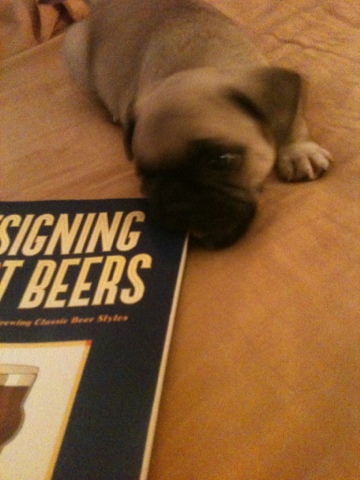
Ezra wants to design a beer recipe (I think)
I want to use a new format for describing my brew day data. It's loosely based on the format used on the Mad Fermentationist blog.

Ezra Saison

Recipe Specifics
Batch Size (gal): 5.5
Total Grain (lbs): 11.76
OG: 1.052
Wort Boil Time: 90 min.

2 liter starter

Grain
10.5 lbs Pilsner malt
.51 lb wheat malt
.75 lb Munich malt
67 g Caramunich

Hops
1.0 oz Hellertau (3.8 AA) @ 90 min
1.0 oz Hellertau @ 42 min
1.0 oz Hellertau @ 0 min

Extras
1 g lemon thyme @ 5 min
5 g chamomile flowers @ 5min
11 g crushed coriander @ 5 min

1/2 tab Whirlfloc
1/2 tsp yeast nutrient

Yeast
Wyeast 3711 French Saison

Mash Schedule
Sacch rest 90 min @ 147 F
Sparge 1 20 min @ 147 F
Sparge 2 15 min @ 150 F

Notes
Made a 2 liter starter (2012-08-26). 117 g of DME (I was short on DME). About 3 tbsp sugar added. Shook a few times. Decent, but not great start.

First brew day with Ezra. He liked the spent grains.

FG: 1.004 on 2012-09-18  
Ezra eating handful of spent grains

Friday, August 31, 2012

Review: BeerClings

Some people like to label their home-brewed beer. A friend of mine makes wine with his wife. Together, they design colorful and clever labels on the computer for each of their wines. For them, the label making is part of the process and part of what they like about making wine at home. But many people are not like that. Designing, printing, and applying (don't forget removing) labels can add hours to the overall process. And, while there may not be a lot of wine bottles to fill per batch, a typical 5 gallon batch of home-brewed beer requires at least 48, 12 ounce bottles, which means that beer labels require more effort. Honestly, I never put labels on my bottles. Bottling, as opposed to kegging, is labor intensive enough.

One option for homebrewers that bottle and would like labels is BeerClings. BeerClings are reusable labels for beer bottles. Homebrewers can easily slap these on their bottles of homebrew. As it states on the product's website, "BeerClings are an exciting answer to the tedious labeling process undertaken by home brewers." I think that statement is accurate.

To test the BeerClings and get a feel for how well they work as advertised, I did the following:

  • I put the labels on two different sized bottles. The labels fit on both.
  • As you can see in the photo, I was able to mark the bottles with dry erase marker. To test this feature, I used a damp paper towel to remove my writing, and then write new words on the label. It worked fine, no problems. 

BeerClings on Bottles
  • I put a label on a beer in the refrigerator and left it there for a couple weeks. The label adhered fine. I took it out of the refrigerator and made sure the label did not come off in the condensation. No problems. The hold was solid.
A Sheet of BeerClings
The BeerClings definitely cling. They are easy to take off and reapply. The maker stated that he "went through a lot of material and the one [he] settled on blew the others away." I believe it.

Unfortunately, there is just one design at the moment. The maker wants to have labels for every beer style eventually.

The cost is $5 for a sheet of 12.

I was impressed by how well the BeerClings worked. I recommend them!

Website: BeerClings.com

Friday, August 3, 2012

Belgian Pale Ale

I was planning on brewing on Sunday. For me and my family schedule, Sunday is a good day to fill the kitchen with brewing equipment, turn on music, and boil water/wort.

However, this Sunday I just wasn't feeling it. Brewing requires a lot of physical and mental energy and approximately five, contiguous hours of time. I was tired. I wanted to sit in the sun and read. I figured that if I pushed myself to brew I would not enjoy it as much, and I don't want to risk associating a poor experience with a hobby that I enjoy.

Arguably, it's possible that I could have started to brew and found myself enjoying the act of measuring grain to mill, stirring the resulting grist in the mash tun, or the pungent aroma of the first, bittering addition of hops to the rolling boil of brown wort.
UK Kent Goldings
Wort


...Not only is it possible, it's likely.

But there are other days to brew.  I ended up brewing on Tuesday (2012-07-31) after work. I knew that with some time to listen to a couple episodes of brewing podcasts (e.g., Basic Brewing Radio, Brewing Network's Sunday Session), calculate mash water volume and temperature, and determine mineral additions for the water, I would be eager to get home on Tuesday and brew. I was.

This time, I brewed a Belgian Pale Ale. The recipe is from Jamil Zainasheff's book, Brewing Classic Styles.  I followed his Antwerp Afternoon recipe, with minor deviations. My version is as follows:

11.3 lbs. German Pilsner malt
.75 oz. CaraMunich malt
4 oz. Belgian Biscuit malt

5 ml of Lactic Acid to mash
2 g of Calcium Chloride to mash
4 g of Epsom Salt to mash
2 g of Baking Soda to mash

1.3 oz. UK Kent Goldings @ 60 min.
1/2 tablet of Whirlfloc @ 15 min.
.25 teaspoon of yeast nutrient @ 15 min.
.7 oz. UK  Kent Goldings @ 0 min.

2 vials of White Labs WLP500 Belgian Ale yeast

1 oz. UK Kent Goldings dry hop in keg 

WLP500 Belgian Ale Yeast
If you have the book you can follow along with me. I am working my way through his Belgian and French Ale chapter. I brewed a Witbier at the beginning of July. I brewed a Belgian Pale Ale on Tuesday. Next, I will brew a Saison. I might brew a Biere De Garde too, we'll see. We can dub this the "Belgian Summer." It's also a means to use the large sack of German Pilsner base malt I have in the basement.

How did this get to be the summer of Belgian beers?

The Witbier was definitely for Kim. She likes the style and I wanted to make a beer that would have her sneaking downstairs to draw from the keg each evening. I have not written a review yet because, at this point, the beer is a bit green. I'm hoping the harsh flavors mellow and that the overall flavor improves. It's certainly drinkable, but not great.

I think the pint of BPA I had at Ommegang inspired this beer. I think that beer is fantastic. Besides, I have brewed a couple American Pale Ales already. Why not compare the brewing experiences and beer styles?

As I understand it, Saisons can be herbal, hoppy, and tangy. The style is supposed to be quite flavorful and a good pairing for many foods. It is a good base beer with which to experiment with herb and fruit additions. I would like to learn more about Saisons, both by reading about the style and by tasting more examples.


If I brew the Biere De Garde, I think the strong, malty profile will make for a good winter beer (the beer needs to be lagered for three months). As you can tell, I'm not sure I will brew it. I might find myself really wanting to make an IPA by then. 

Friday, July 13, 2012

Summer Witte

On July 2nd I brewed a witbier, a Belgian style beer brewed with wheat. The commercial examples use terms like "Belgian white" (e.g., Hoegaarden, Blue Moon) or "witte" (e.g., Ommegang Witte). It's a light golden but hazy beer with coriander and citrus flavors that are refreshing during the summer months.

Kim really likes Ommegang's Witte and wanted me to brew a witbier for her, and I was happy to oblige. Knowing that the beer requires warm fermentation temperatures, I held off on brewing it until summer.

I'm calling this beer, "Summer Witte." I brewed the beer at the beginning of July, it will ferment and carbonate during July, and we'll be able to drink the beer throughout August.

I was surprised by how excited I was about this beer. My wide-eyed glow came from the seasonings and hop additions that the recipe calls for. This beer has crushed coriander seeds, chamomile flowers, and orange zest. I opted to purchase whole leaf hops for the first time, which provided a sense of brewer tradition and aesthetic value. I was also happy with the yeast selection: two vials of White Labs WLP410 BelgianWit II - Platinum, a spicier version.
Hops, Coriander, Chamomile, Orange Zest
Kim helped me pick out the extra ingredients at the health food store. She crushed the coriander seeds and helped zest the oranges, which was no small job, six oranges total.
Zesty!
Brew Date: 2012-06-02
Recipe Name: "Summer Witte" (based on a Jamil's Wittebrew recipe)
Beer Style: Witbier
Batch Number: B8

Original Gravity: 1.050
Expected Final Gravity: 1.011
Expected ABV: 5.0%
IBUs (bitterness): 22.4
SRM (color): 4 SRM

Yeast: 2 vials of White Labs WLP410 Belgian Wit II

Water Chemistry: Remsen well water (Ca 84, Mg 10, Na 3, Cl 8, SO412, CACO3 228)
Added: 6 ml Lactic Acid, 3 g Epsom Salt, 1 g Calcium Chloride (to mash)

Recipe
5.5 lbs. German Pilsner
5.0 lbs. Flaked Wheat
.25 lb. Munich Malt
.5 lb. rice hulls

1.2 oz. Hallertau (leaf) @ 60 min.
.8 oz. Hallertau (leaf) @ 15 min.

1.3 oz. orange zest @ 5 min.
.4 oz. crushed coriander seeds @ 5 min.
.03 oz dry chamomile flowers @ 5 min.

1/2 tablet of Whirlfloc @ 15 min.
.25 tsp. yeast nutrient @ 15 min.
Flaked Wheat
Mash Schedule: 
> 15 min. @ 122 F
> rise from 122 to 154 F over next 15 min.
> 60 min. @ 154 F
> sparge @ 160 F for 15 min.
> sparge @ 170 F for 15 min.

Note: I was short about a gallon of water for my pre-boil volume.
Mash Music: Bon Iver iTunes Session, Phish Superball IX @ Watkins Glen 2011-07-03 (I should have listened to the 07-02 show!)

Boil Time: 90 minutes to reduce DMS
Boil Music: Brewing Network's Sunday Session podcast 2010-01-17 (Vinny from Russian River episode)
Whole Hop Boil
One of the process changes I made to this brew day was to siphon the wort form the brew kettle to the fermenter. I did that to reduce the amount of whole leaf hops in the fermenter. I used a lot of plastic wrap to reduce exposure. After, I managed to break my auto-siphon trying to get a hop leaf out of it. This is a typical problem apparently.

Fermentation Schedule: 
> 1 week @ 68 F
> 1 week @ 70 F
> 1 week @ 72 F

Wednesday, July 4, 2012

Tasting Free IPA

I've been drinking my Free IPA for over a week now. I'm really happy with it. All the research and changes to my brewing process definitely improved the resulting beer.
Free IPA
The beer is not as clear as I would like, despite the Whirlfloc tablet and cold crash period. I plan to use gelatin finings next time. The color is spot on.

When I first kegged the beer it had a brilliant grapefruit aroma. After a week of force carbonation with CO2, that aroma is more subdued, but still present. 

Does it taste like the inspiration beer (i.e., 21st Amendment's Brew Free or Die IPA)? I didn't do a taste test, but I can say that it is close. The beer has lots of hop flavor and little bitterness. 
Corny Keg and CO2 tank
Apart from the water chemistry changes, the other big change was the use of a Cornelius keg. I bought a keg from a friend, purchased and assembled all the hardware, and got a 15 pound CO2 tank. And, yes, I also bought a used refrigerator to put it all in. At some point I may drill holes and turn it into a proper kegerator.

I'm sure there will be a learning process for using and cleaning the keg. In general, racking the beer to a keg and force carbonating the beer is much easier than bottling.

Because the beer is cooled to 45 to 47 degrees Fahrenheit, I force carbonate at 14 psi.

I found the Crockett Brewing pages on Easy Force Carbonation and Balancing your Keg System to be helpful. 

Friday, June 22, 2012

Brewery Ommegang

A couple weeks back, Kim and I took a road trip to Cooperstown, New York to tour Brewery Ommegang. The brewery makes some of the best Belgian style beers here in the States and worldwide. I'm sure I could go on and on about the brewery and the beers (I highly recommend them), but I'm just going to post some pictures and comment.
Ommegang Farmhouse
Ommegang was built in the 1990s but the design is that of a traditional Belgian farmhouse.

We checked in at the gift shop to sign up for the next tour and purchase tasting tickets ($3/person). We had a short wait so we went to the cafe/bar.
Cafe Ommegang
Fermentation is pretty awesome.
Beer, wine, bread, pickles, cheese, fish sauce, sake, yogurt, sauerkraut, vodka, etc.
Belgian (style) breweries:
Ommegang, Maredsous, Duvel, Liefmans, Brasserie  D'Achouffe
Belgian Pale Ale and cappuccino 
Cheers!
Tasting Ommegang's Belgian Pale Ale, fresh from the tap at the brewery, may have been the high point of the day for me. Really! We could have left right then and I would have been happy. I've had the BPA before, but it didn't taste like this. So much flavor. It even seemed like it had a slight barnyard Brett flavor (I'm fairly certain no Brettanomyces was used), which I loved and I hope I never forget.
Our tour guide in front of bottling equipment
The half hour tour was good. The brewery is fairly small. Our tour guide talked about how beer is made, the fermentation, and bottling. They have a clean room with an open fermenter. The beer ferments at 75 F!

After the tour, our guide led us to the tasting room. He put pretzels and various cheese spreads and sauces on the counter. We sampled all six of the Ommegang beers, from lightest (Witte) to darkest (Three Philosophers). The tour guide described each of the beers and the special herbs and spices added to each (I guess the Belgians didn't buy in to the whole Reinheitsgebot thing).
Herbs and Spices
After the tasting, we asked to be seated outside to enjoy a Sunday afternoon lunch/dinner. We had rain showers on and off that day, but luckily it held out long enough for us to eat and enjoy glimpses of the sun.
Outdoor seating
Smiling
and a little red after the tasting
Hennepin ,a farmhouse Saison
Witte, a Belgian style wheat ale, or witbier
Checkout this menu!

Frites (twice-fried fries) with two sauces:
1) Abbey Ale and cumin ketchup and 2) Mustard with Witte Ale and honey
Moules Witte (mussels in Witte broth and Shiitake mushrooms)
Crepe with spinach and goat cheese
Crepe with duck confit and Shiitake mushrooms
Obviously, the meal was stunning. Visually appealing, good execution, and lots of flavors. Very enjoyable. Not too expensive either (though watch yourself when you pass back through the gift shop--that can get expensive, trust me).

I recommend visiting Brewery Ommegang for your own Upstate New York flavor adventure. And if you can't make it, look for their beers. All six are excellent representations of their respective beer style. Rather than a bottle of wine, pick up a bottle of Ommegang to take to your friends house for dinner. Cheers!
Ommegang Abbey Ale and Hennepin

Monday, June 18, 2012

Hop Growing, Take 2

This last Thursday (2012-06-14) I planted two more hop rhizomes. The rhizomes I bought and planted earlier in the spring did not come up. Looking at these new rhizomes--which I bought from Freshops this time--are sturdier, healthier and more robust than the weak little twigs I had before. That difference in quality gives me hope that these will indeed shoot out of the soil, climb themselves up the guide wire, and dangle those cirtrusy cones of hop goodness in front my nose.
Centennial Tag
The new rhizomes are both Centennial hops. Centennial is one of the "Three C" hops of American hops (the other two being Cascade and Columbus). It has a floral and citrus flavor and aroma with a 9 to 12% Alpha Acid. The pungent flavor and Alpha Acid rating causes the hop to be described as a Super Cascade hop. It can be used for bittering and flavor (i.e., dual-purpose). Great for Pale Ales and India Pale Ales--my favorite.
Waiting
Many great beers use Centennial as the flavoring addition. Stone's Ruination IPABell's Two Hearted Ale, and Founders' Centennial IPA are just a few examples. My Free IPA, a clone of 21st Amendment's Brew Free or Die IPA uses Centennial as the 20 minute, flavoring addition. The near legendary Centennial Blonde recipe my BierMuncher on the HomebrewTalk.com forums features Centennial hops (at the moment, 2318 gallons!! have been brewed by homebrewers--it's on my list). I'm happy with my choice and I hope to use a lot of Centennial hops in the future.